Good Figs, Bitter Cup, Sure Hope
 From the reading for October 26Proverbs 11:8–17 · 2 Thessalonians 1 · Jeremiah 24–25
Some days the Bible hands us hard words alongside sweet ones. Today we hear about a city built up by blessing, a church holding firm under pressure, and a prophet carrying a cup no one wanted to drink. Through it all stands a God who is both perfectly just and astonishingly kind.
Proverbs 11:8–17 — Words That Build or Break a City
These proverbs widen the view from one person to the whole neighborhood. Notice how often the mouth appears: "With his mouth the ungodly man destroys his neighbor" (Proverbs 11:9), and "By the blessing of the upright a city is built up, but by the mouth of the wicked it is torn down" (Proverbs 11:11). Our words are never truly private. They either strengthen the shared life of a family, a church or a town, or they quietly chip away at it.
So wisdom looks like restraint and trust. Instead of showing contempt, "a man of understanding remains silent" (Proverbs 11:12). A gossip spills secrets, but "a trustworthy person keeps a confidence" (Proverbs 11:13). Wisdom is humble enough to seek "many counselors" (Proverbs 11:14). And kindness turns out to bless the kind person too: "A kind man benefits himself, but a cruel man brings trouble on himself" (Proverbs 11:17). The righteous are not loners. When they thrive, "the city rejoices" (Proverbs 11:10).
2 Thessalonians 1 — God Sees Your Suffering and Will Set Things Right
Paul, Silvanus and Timothy write to a young church in Thessalonica that is under real pressure. Paul does not begin by scolding. He begins with thanks: "your faith is growing more and more, and your love for one another is increasing" (2 Thessalonians 1:3). He even boasts to other churches about their "perseverance and faith in the face of all the persecution and affliction" they are enduring (2 Thessalonians 1:4).
Then he lifts their eyes. Their faithful endurance is not a sign that God has forgotten them; it is "clear evidence of God's righteous judgment" (2 Thessalonians 1:5). God will "grant relief to you who are oppressed" when "the Lord Jesus is revealed from heaven" (2 Thessalonians 1:7). Paul speaks soberly about those who "do not know God and do not obey the gospel" (2 Thessalonians 1:8), who will be "separated from the presence of the Lord" (2 Thessalonians 1:9). But the goal of that day is glory: Jesus comes "to be glorified in His saints" (2 Thessalonians 1:10). Until then, Paul prays that God "will powerfully fulfill your every good desire and work of faith" (2 Thessalonians 1:11), all "according to the grace of our God and of the Lord Jesus Christ" (2 Thessalonians 1:12).
Jeremiah 24–25 — Judgment Is Real, and So Is Grace
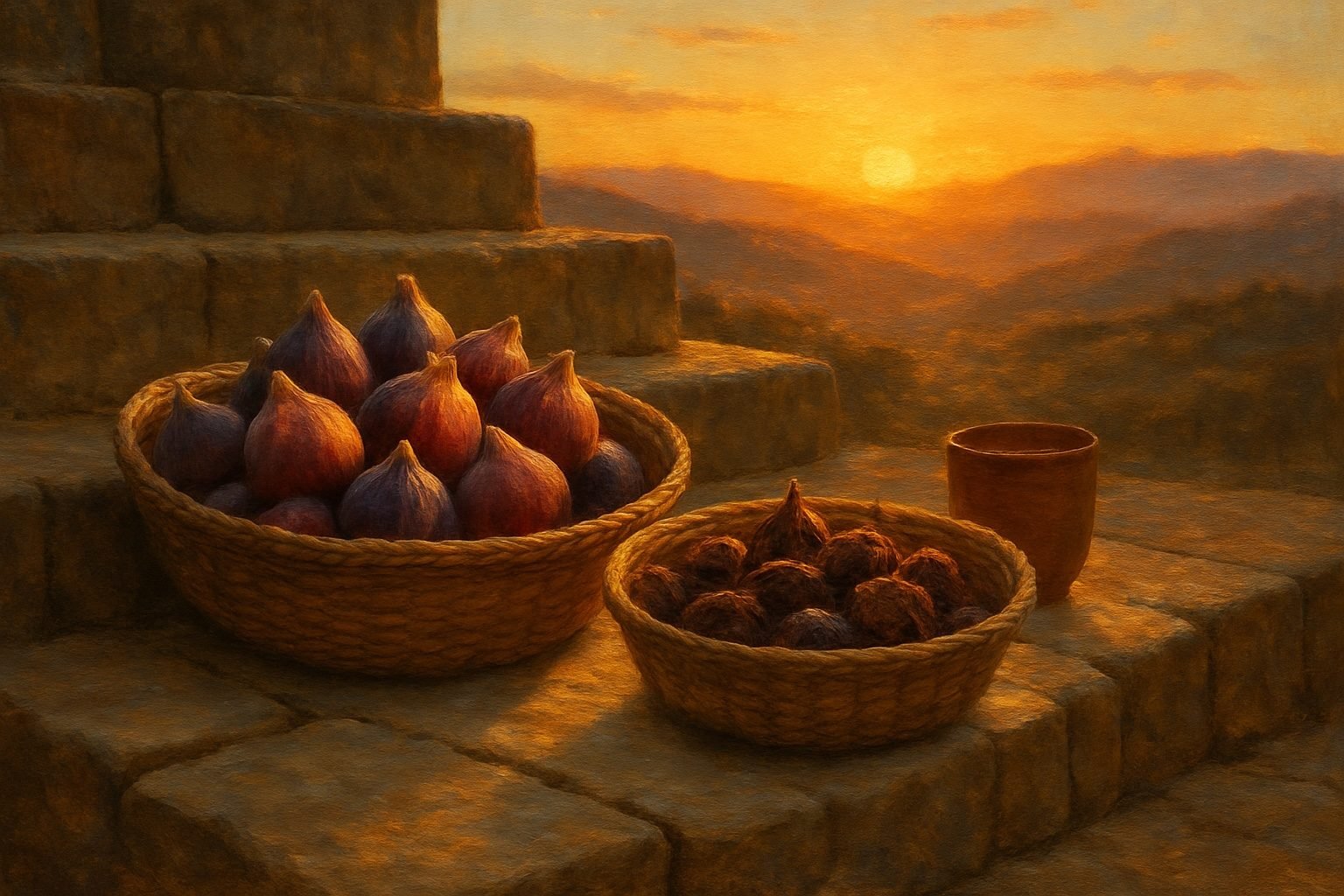
Jeremiah 24 comes after Babylon carried King Jeconiah and many leaders into exile. Those left behind in Jerusalem may have felt like the fortunate ones. But God shows Jeremiah two baskets of figs and turns that thinking upside down: the exiles are the good figs. God promises, "I will keep My eyes on them for good and will return them to this land. I will build them up and not tear them down" (Jeremiah 24:6). Notice where their hope comes from: "I will give them a heart to know Me" (Jeremiah 24:7). Their future rested on God's gift, not their own record.
Jeremiah 25 explains why judgment came. For twenty-three years Jeremiah had spoken "again and again, but you have not listened" (Jeremiah 25:3). So God would bring Babylon, and the nations would serve its king "for seventy years" (Jeremiah 25:11). Even that number held hope, because the judgment had an end, and Babylon itself would later be punished (Jeremiah 25:12). Then comes the vivid image of "this cup of the wine of wrath" (Jeremiah 25:15), passed to nation after nation, beginning with Jerusalem: "I am beginning to bring disaster on the city that bears My Name, so how could you possibly go unpunished?" (Jeremiah 25:29). No one stands outside God's justice, not His own people and not the mightiest empire.
How They Tie Together
All three passages insist that God takes seriously how we live. Proverbs shows it in daily life, where words and choices build up or tear down. Jeremiah shows it in history, where a people who would not listen tasted the cup of wrath. Paul shows it at the end of history, when Jesus is revealed and every wrong is put right. Yet in each passage grace shines through. God gives exiles a new heart. He counts struggling believers worthy by His grace. He builds up a city through the blessing of ordinary, faithful people.
The bridge is Jesus. On the night before His cross, He prayed in the garden about a cup, and He chose to drink it in our place. Because He bore that wrath, everyone who trusts Him can look toward the day of His appearing not with dread but with wonder, as people in whom His name is "glorified" (2 Thessalonians 1:12). Like the good figs, we are kept and planted by a God who keeps His eyes on us for good.
Take It With You
• Before you speak about someone today, ask: will these words build up or tear down?
• If following Jesus is costing you something, remember that God sees it and has promised relief.
• Thank God that your hope rests on the heart He gives and the cup Jesus drank, not on your own record.

Life is short. Where are you going?
None of us knows how much time we have. “What is your life? You are a mist that appears for a little while and then vanishes” (James 4:14). One day this life will be over — so the most important question you will ever answer is this: do you know where you are going when it is?
The Bible says, “Man is appointed to die once, and after that to face judgment” (Hebrews 9:27). If you died today, would you be ready?
Are you a good person?
Most of us think we are. But God doesn’t measure us against other people — He measures us by His Law. Look honestly at the Ten Commandments (Exodus 20:3–17):
- You shall have no other gods before Me.
- You shall not make for yourself an idol.
- You shall not take the name of the LORD your God in vain.
- Remember the Sabbath day by keeping it holy.
- Honor your father and mother.
- You shall not murder.
- You shall not commit adultery.
- You shall not steal.
- You shall not bear false witness.
- You shall not covet.
Have you ever told a lie — even a small one? Have you ever taken something that wasn’t yours? Have you ever used God’s name as a curse word? Have you ever wanted what belongs to someone else? Jesus said that anyone who looks with lust “has already committed adultery … in his heart” (Matthew 5:28), and the Bible says “everyone who hates his brother is a murderer” (1 John 3:15).
If we’re honest, we have all broken God’s Law — and “whoever keeps the whole law but stumbles at just one point is guilty of breaking all of it” (James 2:10). “There is no one righteous, not even one … there is no one who does good, not even one” (Romans 3:10–12).
That leaves every one of us guilty before a holy God. “The wages of sin is death” (Romans 6:23), and “whoever rejects the Son will not see life. Instead, the wrath of God remains on him” (John 3:36). This is why our world is full of tragedy — and without Christ, every life ends in the greatest tragedy of all.
But God made a way
“God proves His love for us in this: While we were still sinners, Christ died for us” (Romans 5:8). Jesus lived the perfect life we never could, and on the cross He took the punishment we deserved: “God made Him who knew no sin to be sin on our behalf, so that in Him we might become the righteousness of God” (2 Corinthians 5:21). Three days later He rose from the dead (1 Corinthians 15:3–4).
It’s like standing guilty in court when the judge steps down and pays your fine himself. Forgiveness is a free gift — you can’t earn it: “It is by grace you have been saved through faith … it is the gift of God, not by works” (Ephesians 2:8–9). “The gift of God is eternal life in Christ Jesus our Lord” (Romans 6:23).
“The thief comes only to steal and kill and destroy. I have come that they may have life, and have it in all its fullness.” Jesus — John 10:10
What will you do with Jesus?
“Repent and believe in the gospel!” (Mark 1:15). Turn from your sin, and put your trust in Jesus alone — “if you confess with your mouth, ‘Jesus is Lord,’ and believe in your heart that God raised Him from the dead, you will be saved” (Romans 10:9). Don’t put it off — “now is the time of favor; now is the day of salvation!” (2 Corinthians 6:2).
And when you turn to Him, you won’t be met with a frown — you’ll be met with a celebration. Jesus said, “there is joy in the presence of God’s angels over one sinner who repents” (Luke 15:10). God says, “I take no pleasure in the death of the wicked, but rather that the wicked should turn from their ways and live” (Ezekiel 33:11). He is “mighty to save. He will rejoice over you with gladness … He will rejoice over you with singing” (Zephaniah 3:17). Like the father who ran to embrace his lost son, He is waiting with open arms — and heaven throws a party when you come home (Luke 15:20–24).
If you died today, where would you spend eternity? Today you can be forgiven, made new, and have real, abundant life — now and forever.
Comments